rhoadley.net music research software blogs
vimeo youtube gallery
five pieces sextet through the sharp hawthorn only connect in principio miscellaneous concertino three pieces for two pianos four archetypes petrochemicals copenhagen ambience hello histrionica telephony many worlds 127 haiku 128 haiku triggered touching sound 127 messages
calder's violin fluxus fluxus tree player piano three streams quantum canticorum december variations december mobile semaphore piano glyphs how to play the piano choreograms edge violations homage unthinking not songs graffiti
devices: gaggle gagglina wired threads glyphs metapiano digiphone
NB All material on this site is © Richard Hoadley (and others), 1980-2023
Three Pieces for Two Pianos
1992
Composed: March-November 1992
First performed: Royal Academy of Music, London, 1995; Philip Mead and Steve Guttman, pianos
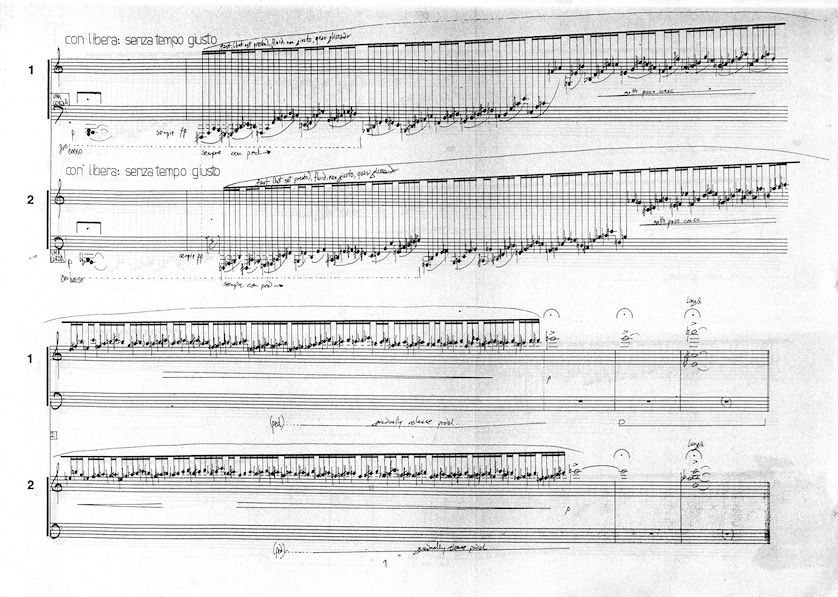
The piece exhibits, in various ways, a number of compositional developments which have occurred since I had begun teaching composition two years before. This only emphasised to me the need for simplicity of gesture and the careful balancing of overall form. In addition, experience in electroacoustics and my own interests in computers had promised for some time to influence the processes of composition I had been using in instrumental music. Quite often my ideas have arisen from improvisation and I have felt that these ideas have been thwarted in the transfer onto paper, usually resulting in the need to construct abstract methods of composition in order to fill larger textural blocks or gestures. Using 'methods' to do this has the disadvantage that they can tend to produce similar overall results, in spite of great efforts to avoid this. Using basic equipment such as a computer-based sequencer, a music notation program, and a midi keyboard, it has been possible to incorporate a number of elements of improvisation to the process of composition. These can be in the form of a basic 'balance' of areas of material, or the distribution of pitches and/or rhythms within larger or smaller gestures. It is also possible, of course, to check more accurately than I am able to with my limited keyboard ability, those abstract methods of composition that are necessary.
It should be emphasised that the benefits of using technology to 'help' with composition do not necessarily extend to saving time. Indeed, my own experience suggests that using technology slows the process considerably, but these problems are balanced by the expansion of material it allows, the input of wilder and less organized elements and the ability to audition the material reasonably effectively.
Sound versions available: mp3
mp3
All performances here are copyright Richard Hoadley, Philip Mead, Steven Guttman and the SPNM.